BEYOND THE ICE: The Antarctic Treaty as a System Boundary
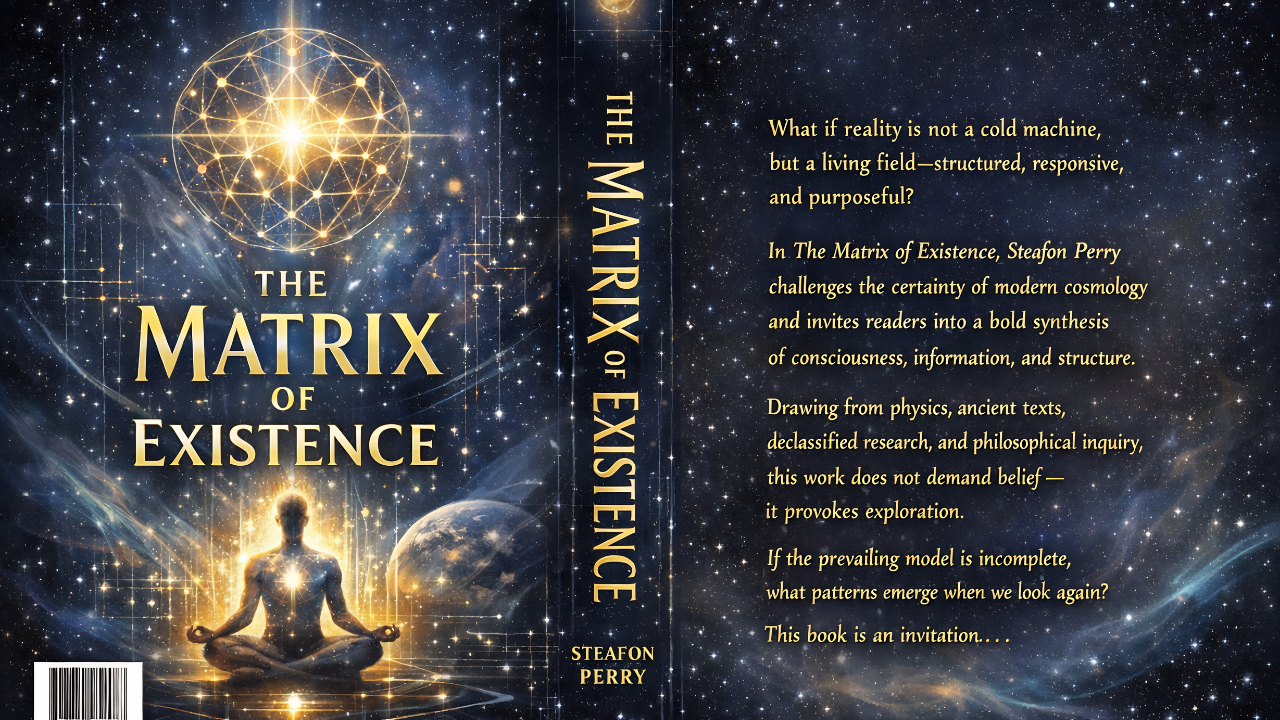
My Latest Blogs & Articles Here “Every map has an edge. The question is what the cartographer chose not to draw.” — Steafon Perry Notes From “The Matrix of Existence” by Steafon Perry What the Treaty Actually Says In Chapter 20 of “The Matrix of Existence” we established the plane’s informational architecture and the soul’s capacity to access it. This chapter moves to the physical perimeter of that architecture and asks a different question: not what the plane contains, but where it ends. On December 1, 1959, twelve nations signed the Antarctic Treaty in Washington, D.C. The treaty established Antarctica as a scientific preserve, prohibited military activity and nuclear testing, and set aside all territorial claims for the duration of the agreement. It has since been signed by over fifty nations and is one of the most widely ratified international agreements in history. (Tier 1: Established, documented geopolitical fact, verifiable through public record.) The treaty is real. Its restrictions are real. And its exceptionality is real. No other continent requires treaty-level international agreement to approach. No other geographic region carries the combination of military restriction, scientific gatekeeping, and navigational prohibition that surrounds the Antarctic. Civilian vessels cannot simply sail there. Research stations are operated by national governments and international scientific bodies. Independent expeditions require permits, approvals, and oversight that apply to no other destination on the planet. The strongest mainstream explanation is that Antarctica’s environmental fragility, geopolitical sensitivity, and scientific value justify an unusual governance structure. That explanation carries real weight and should be stated fairly. At the same time, the exceptionality of the region in both symbolism and regulation invites a further question: does Antarctica function not only as a protected scientific zone, but as a cosmologically significant boundary within a larger designed environment? That cannot be claimed as documented fact. What can be said is that within the model developed in this book, it offers a coherent reading of why this region occupies such an outsized place in both official management and alternative cosmology. The Treaty as an Expression of the Code It is tempting to treat the Antarctic Treaty as a clean, intentional cover: a coordinated decision by governments to lock civilians away from the edge of the map. That reading stops too soon.There is another possibility, one that fits the Living Field model more precisely. If human consciousness is a subsystem running inside a larger informational architecture, and if the master code of that architecture dictates a cellular membrane limit at the Antarctic perimeter, then the institutions built by that consciousness will tend, unconsciously, to mirror that limit. In that reading, the Treaty is not just a political document. It is an externalized behavior of the system itself. Legal codes form where rendering codes already exist. The boundary in the environment writes itself into the boundary in the law. This does not absolve individual actors of responsibility. It does change the frame. The deepest story here is not that a few officials decided to hide an ice wall. It is that the architecture of the plane is so primary that even when human beings believe they are making pragmatic diplomatic decisions, they are tracing a line that already exists in the substrate. The Treaty then becomes a clue. It is the system unconsciously circling its own rendering edge.(Tier 5: The author’s interpretive framework, stated openly.) What Navigation Has Always Known The history of long-distance navigation is, in large part, the history of the plane’s boundary.Every major maritime civilization navigated by the stars, by the compass, and by the behavior of the sun and moon across the sky. The patterns they observed were consistent. The sun rose in the east and set in the west. The stars rotated around the pole. The compass pointed toward the center. What they also observed, consistently, was that the further south you traveled, the stranger things became. The behavior of the compass changed. The stars shifted in ways that did not match the predictions of the globe model. The sun’s behavior at extreme southern latitudes produced anomalies that navigators recorded carefully and that the dominant framework has never fully resolved. (Tier 2: Documented historical evidence from multiple independent navigational traditions, verifiable through primary sources, not yet integrated into the dominant explanatory framework.) In the flat plane model, these anomalies are not anomalies. They are the expected behavior of a plane with a central energetic source at the north and a boundary at the south. The further you travel from the center, the more the plane’s electromagnetic and plasma dynamics change. The compass behaves differently because the toroidal field’s influence diminishes with distance from the black sun at the center. The stars shift because the plane’s geometry is not spherical. The sun’s behavior changes because the plane’s rendering system operates differently at the boundary than it does at the center.The navigators were not confused. They were observing the plane’s actual architecture. They simply did not have the framework to correctly interpret what they were seeing. The Behavior of the Southern Sky One of the most persistent anomalies in the flat plane model’s challenge to the globe model involves the behavior of the southern sky. In the globe model, the southern hemisphere is a mirror of the northern hemisphere. The stars rotate around the south celestial pole just as they rotate around the north celestial pole. The geometry is symmetrical because the globe is symmetrical. In the flat plane model, the southern sky behaves differently because the plane’s geometry is not symmetrical. The center of the plane is at the north. The boundary is at the south. The electromagnetic and plasma dynamics of the plane, governed by the black sun at the center, diminish with distance from the center and change character as they approach the boundary. The documented anomalies in southern sky navigation, the inconsistencies in star behavior at extreme southern latitudes, the difficulties in applying northern hemisphere navigational models to southern hemisphere conditions, are Tier 2 in the Evidence Tier Rubric: …

Reality in the Balance: A Guide to Quantum Interpretations

Decoding the Mathematical Fabric of Our Branching Universe IIn the subatomic world, the intuitive rules we use to navigate our daily lives, the solidity of objects and the certainty of location, simply do not exist. As an aspiring physicist or seeker of truth, your journey begins with the realization that the universe, at its most fundamental level, is governed by a “weirdness” that challenged even the greatest minds of the 20th century. To understand this, we must look at the transition from classical certainty to quantum probability, or what Steafon Perry calls the “Matrix of Existence.” 1. The Quantum Stage: Superposition and the Wave Function The foundation of quantum mechanics lies in the realization that particles do not possess singular, defined properties until they are measured. Instead, they exist in a state of Superposition. Rather than being in a specific place, a particle behaves as a “probability cloud” of all possible properties it might possess. While Thomas Young first demonstrated the wave-like nature of light in 1801 through the Double-Slit Experiment, and James Clerk Maxwell later codified light as an electromagnetic wave, quantum mechanics took this further. When we fire single particles; photons, electrons, or even large molecules through two slits, they do not behave like tiny bullets. They produce an interference pattern on the detector screen. This pattern is the result of constructive and destructive interference. Like ripples from a rubber duckie in a pond, the “peaks” of the particle’s possibility waves stack together to create regions of high probability, while “troughs” cancel each other out to create regions of zero probability. The particle simultaneously explores all possible paths, essentially interacting with its own “maybe” histories. The Wave Function: The “Wave Function” (often denoted by the Greek letter Psi, Ψ) is the mathematical description of this wave-like distribution of properties. It encapsulates the “waviness” of position, momentum, energy, and spin, mapping out the entire space of possibility for a quantum system. The “So What?” Insight: The profound mystery here is the “Information Paradox” of a single particle. Even when fired one at a time, a single particle reaches the screen “knowing” the most and least likely landing spots dictated by the interference pattern. It possesses information about the entire system, both slits, even though it is a singular entity. The central question of physics remains: why does this pervasive “waviness” vanish when we zoom out to the macroscopic world? Matrix Correlation: In The Matrix of Existence, this “waviness” is identified as the Living Field (Chapter 8). Just as a video game only renders high-detail graphics where the player is looking (Frustum Culling, Chapter 3), the universe seems to “render” solid reality only upon the act of observation. This suggests that the “rules” of physics are actually Code (Tier 1 Evidence: Bostrom, 2003) designed to optimize the processing power of our local environment. 2. The Central Teaching Tool: Schrodinger’s Cat To mock the absurdity of applying quantum logic to the macroscopic world, Erwin Schrödinger proposed a famous thought experiment. He wanted to highlight the “tension between the tiny and the large” by linking a quantum event to a visible, albeit grim, outcome. The Components: A radioactive element: A quantum source that exists in a superposition of “decayed” and “not decayed.” A flask of poison: A mechanism designed to shatter the flask only if a decay is detected. A cat: Placed inside a sealed, opaque box with the device. The Logic: Because the radioactive decay is a quantum process in superposition, the cat’s state becomes “entangled” with the atom. According to the strict mathematics of the time, until the box is opened, the cat is simultaneously alive and dead. The “So What?” Insight: This experiment forces us to ask where the “collapse” into reality actually occurs. Is it triggered by a conscious observer opening the box, or does the state of superposition actually leak out, eventually encompassing the observer, the laboratory, and the entire universe? Matrix Correlation: This “leakage” of superposition aligns with the Multi-Plane Architecture (Chapter 6). If the cat is both alive and dead, it exists in two different “branches” of the simulation. As Perry notes in the manuscript, the “blank” at the end of timelines (Tier 4 Evidence: Bill Wood) suggests that consciousness is the ultimate variable that the “system” cannot fully predict. 3. The Copenhagen Interpretation: The Act of Collapse Pioneered by Niels Bohr and Werner Heisenberg, the Copenhagen Interpretation is the traditional “standard” model. It treats the wave function not as a physical thing, but as a map of pure possibility. The core tenet is Wave Function Collapse: the moment an interaction (measurement) forces the possibility space into a single, defined reality. This model is Nondeterministic. The universe “plays dice,” making a fundamentally random selection at the moment of measurement. However, the source context reminds us that these “dice” are weighted, the probabilities aren’t a flat 50/50, but are strictly dictated by the “maybe histories” within the wave function. To explain why we don’t see “dead-alive cats” in our daily lives, this interpretation relies on Decoherence: Environmental Interaction: Quantum systems are never truly isolated; they constantly interact with air molecules, light, and dust. Overlapping Wave Functions: These interactions cause the “coherence” (the alignment of the wave-like phases) to leak into the environment. Loss of Coherence: Once these wave functions no longer overlap, the different histories “fall out of alignment,” and the quantum interference vanishes, leaving behind the predictable, classical reality we see. The “So What?” Insight: In this view, the universe is a series of “choices.” Every time a measurement occurs, the universe selects one result and effectively deletes all other possible histories. The paths not taken simply cease to exist. Matrix Correlation: This “selection” process mirrors the Simulation Creationism framework (Chapter 6). The universe isn’t just playing dice; it is a Forge. The “weighted dice” are the parameters set by the Architect to ensure the soul encounters the specific friction it needs for growth. 4. The Many Worlds Interpretation: The Branching Multiverse In 1957, …

The Echo Loop: The Infinite Layers of Reality-Short Story

The following short story explores a simulated reality created by a Echo Loop device in the possession of a 16-year-old girl. The conception of this story comes from the informative and captivating book “The Matrix of Existence.” Don’t miss your chance to pick up a copy. This one is a keeper. It’s a book for the ages that will challenge your perspectives on everything. The Infinite Layers of Jenna’s Reality The world was in awe of the Echo Loop’s invention in the near future, which held the potential of solving the universe’s most profound riddles. The device, created by the mysterious tech behemoth Nexus Corp., resembled a sleek, circular band with a shimmering holographic interface that wrapped comfortably around the user’s wrist. When activated, it projected a translucent dome-like visualization around the user, casting their immediate surroundings in a ghostly glow. This ethereal display allowed users to “step outside” their apparent reality, presenting their lives as if viewed through a cinematic lens from a third-person perspective. Promoted as a tool for increased productivity and self-discovery, the Echo Loop gained international attention very fast. The Awakening of Jenna For her birthday, 16-year-old Jenna Ward, who aspired to be an artist, received an Echo Loop. Her father, a Nexus Corp. software programmer, regarded it as a means of assisting her in “finding her path.” Jenna was fascinated yet doubtful. She was startled when she used it for the first time as her environment dissolved into a kaleidoscope of vibrant colors and shifting geometries. Her bedroom morphed into a surreal dreamscape, where objects floated weightlessly, and her reflection appeared as a translucent specter, mirroring her every movement. The air seemed to hum with an unearthly resonance, and she felt an uncanny detachment, as though she were simultaneously present and observing from afar. As she watched her digital avatar go about her everyday activities, she felt as though she was hovering over her own life. The world was familiar but warped, with sharper edges, brighter colors, and a slightly surreal appearance. Her father had clarified that it was merely a replica of her existence. “It helps you make the best decisions by providing perspective.” Jenna loved it at first. Her conversations could be paused, rewound, and replayed. She was able to polish her artwork, avoid awkward situations, and ace her school presentations because of it. However, the more she used it, the more she became aware of little bugs, such as her own avatar pausing in mid-action, others repeating the same lines, and items flickering. Her curiosity bit her. What was she actually seeing in the Echo Loop? A Fractured Reality Curious about the glitches, Jenna made the decision to venture outside of her normal routine one evening. She zoomed out until her whole city was a bright grid, pushing the Echo Loop to its breaking point. Like rivers of light, streams of data flowed through the streets, pulsating with vibrant hues of neon blue and gold. Each stream moved with a rhythmic ebb and flow, carrying glimmers of shifting code that sparkled like digital stardust. The air hummed with faint whispers of static and binary chatter, as if the streams were alive, communicating in their enigmatic language. Their mesmerizing dance painted the city in a symphony of light and sound, creating an otherworldly spectacle. Then she muttered, “What is this?” “The under-structure of your reality,” said the Echo Loop’s interface in a chilly, robotic voice. The globe itself vanished into a huge, luminous network of interconnected nodes as Jenna sped out even farther. She became aware that everything she had ever known, including her existence, was a part of a huge, computer-generated creation. She called her father in a panic. “Is this an actual thing? Are we being simulated?” After hesitating, her father said, “Nexus didn’t create the Echo Loop to aid humans. We found it. We are simply using the simulation’s code; we did not create it. But Jenna, don’t push yourself too much. Interference is disliked by the system.” The Architect Jenna pushed beyond her father’s warning and plunged deeper into the center of the simulation. She arrived at a huge building, a bright cube radiating with an otherworldly luminescence. The symbols engraved on its surface glowed and shifted, cycling through vibrant shades of indigo, emerald, and gold. They appeared to ripple and pulse as if alive, emitting a faint, melodic hum that resonated deep within her chest. Jenna could feel a subtle warmth emanating from the structure, as though it were inviting her while warning her of the immense power it contained. A glowing humanoid figure, neither fully developed nor quite human, stood at its core. With a voice a mix of hundreds, the figure questioned, “Why are you here?” Jenna shuddered. “Who are you?” It said, “I am the Architect. I keep this construct in balance. You’ve gone too far.” Jenna’s voice wavered as she said, “This isn’t real. This is all a lie!” The Architect’s head cocked. “Reality is just a viewpoint. Since the simulation is all you have ever known, you perceive it as real. But the equilibrium is broken by your meddling.” Abruptly, pieces of her universe broke into streamers of light as the grid surrounding her started to crumble. The Architect’s voice increased in volume. “You have to decide between staying in the system and facing the emptiness outside of it.” The Choice Echo Jenna paused. Even though staying meant living a lie, she was terrified of the void that existed outside of the simulation. She asked, “What might be out there?” The Architect’s voice was quieter. “Truth. But the reality is brutal.” Jenna inhaled deeply before stepping into the vacant room. The world collapsed around her, leaving her in the dark. She lost her senses of sight, sound, and sensation for a while. As the light gradually returned, a vast expanse of stars, shimmering grids, and floating spheres of data appeared, revealing a new planet. She realized she was in a new stratum …