
The Architecture of Reality
By Steafon Perry
Introduction: The Felt Shift
Lately, I have felt something I can only describe as a migration in the rules of the world. Not just “a lot is happening” fatigue. Not just political disagreement. More like the medium we used to share, the shared reality layer, has started to behave differently.
When people tell me it feels like the “texture” of reality changed, I get it. What I think we are actually watching is not only a social divide but also an ontological fracture. In plain language, people are no longer disagreeing inside the same frame. They are operating with different assumptions about what counts as real, what counts as evidence, and what counts as meaningful.
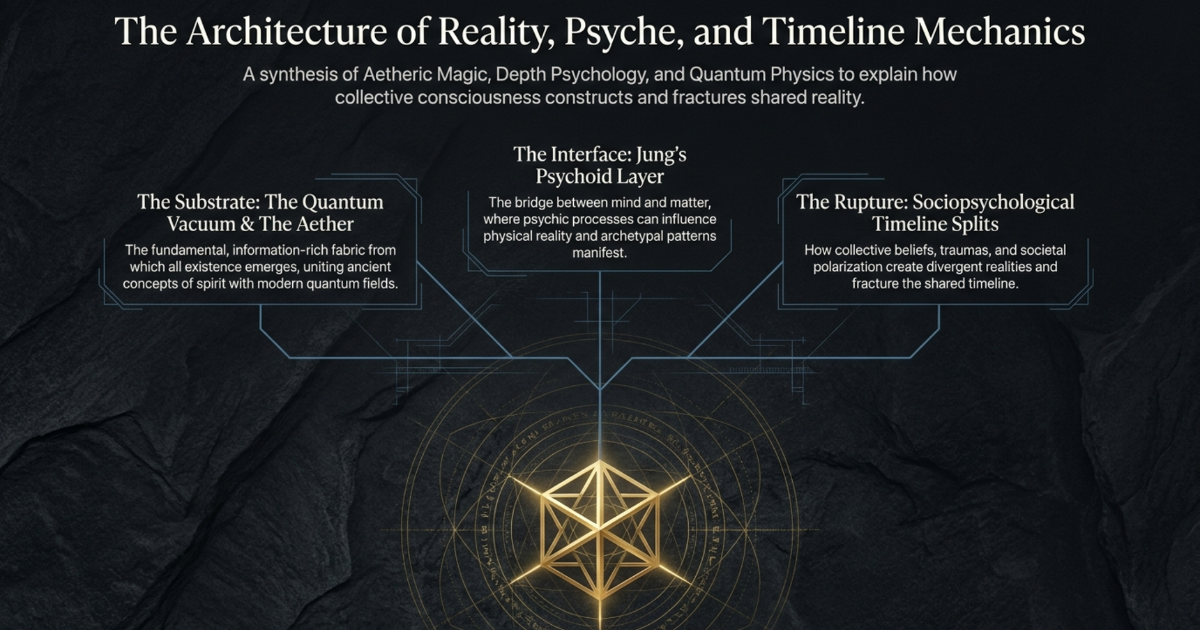
My working synthesis pulls from aetheric theory as a symbolic and energetic vocabulary, selective interpretations of quantum physics as an informational metaphor, and consciousness research as the missing variable in modern institutional models. The “Timeline Split,” as I use it, is a way to name a literal divergence in the informational field that people participate in through attention, belief, and coordinated action.
This “receiver” framing aligns with ideas from The Living Field Studio, especially the theme that perception is tuned, not merely received, as explored in “Tuning the Receiver: Reconnecting to the Living Field”.
What follows are five truths that sound counterintuitive at first but start making sense once you see reality as participatory and informational.
Takeaway 1: Magic is a Discipline of Pitch, Rhythm, and Concentration
The High Cost of Mental Static
When I talk about Artifice, or aetheric magic, I am not talking about a genetic gift. I am talking about a discipline. The difference between an Adept and an accidental “Wizard” is not talent; it is repeatability, containment, and precision.
In my model, influence over reality depends on correctly focused thought. That “correctly” matters. It is not vague wishing. It is more like tuning, like music. Pitch, rhythm, and concentration are not poetic flourishes here, they are the mechanics.
This is why I point people to the physical metaphor of resonance. The Earth ionosphere cavity supports electromagnetic standing waves known as the Schumann resonances, with a fundamental mode often cited around 7.83 Hz. I am careful with the claim: I am not saying that frequency proves magic. I am saying resonance is a real phenomenon, and it is a useful scaffold for understanding why coherence, timing, and stability matter in any practice of intention.
Where things break today is concentration. Our environment is engineered for fragmentation. Attention is constantly interrupted, anxiety is normalized, discomfort is chronic, self-doubt is cultivated. If you cannot hold a steady signal internally, you become programmable externally. In that condition, you do not architect your reality tunnel. You inherit whatever tunnel the environment can impose.
And yes, confidence is functional. If conviction collapses, the spell collapses. Even if you translate “spell” into psychology, the mechanism still stands. Doubt breaks follow-through. Broken follow-through breaks outcomes.
Takeaway 2: The “Psychoid” Layer is the Bridge Between Mind and Matter
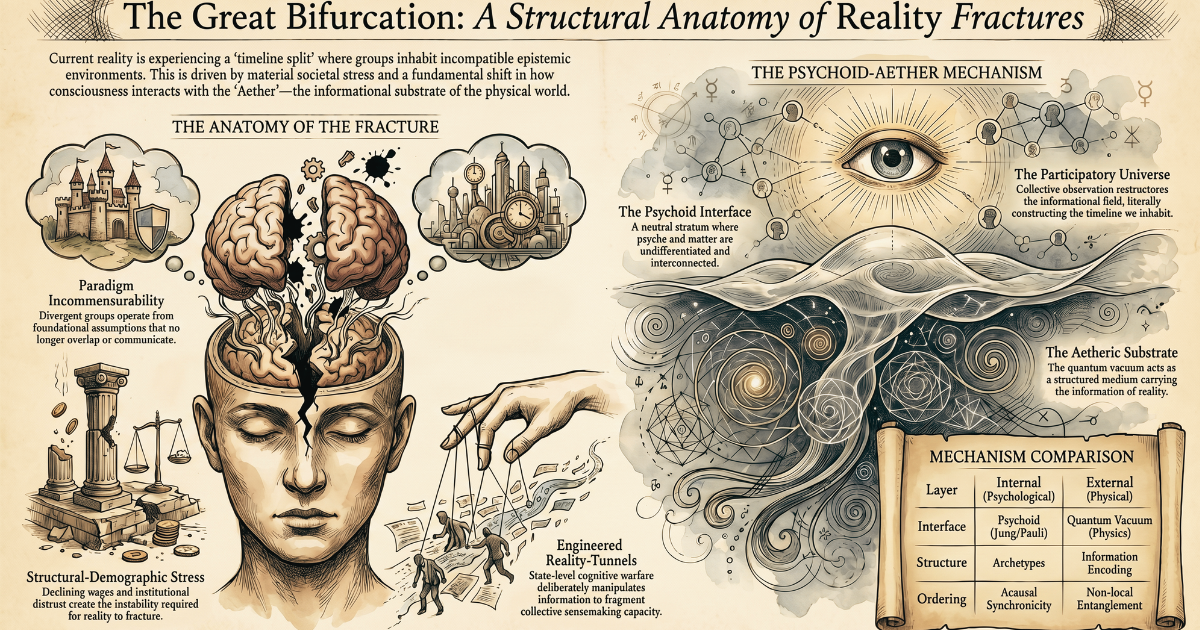
Where Thoughts Become Things
I lean on the psychoid concept because it gives me a language for a bridge, a tertium, between the physical and the psychical. One reference point for the term is “Psychoid” (Junguipedia), and the historical context of Jung and Pauli’s shared concern with psychophysical unity is outlined in “Jung and Pauli: A Meeting of Rare Minds” (Princeton, PDF excerpt).
Here is how I use it: the psychoid is the interface layer where “inner” and “outer” have not fully separated yet. This is where thoughts can become events, not through cartoon causality, but through patterning. Your internal state influences what you notice, what you reinforce, what you tolerate, what you pursue, and what you coordinate with others.
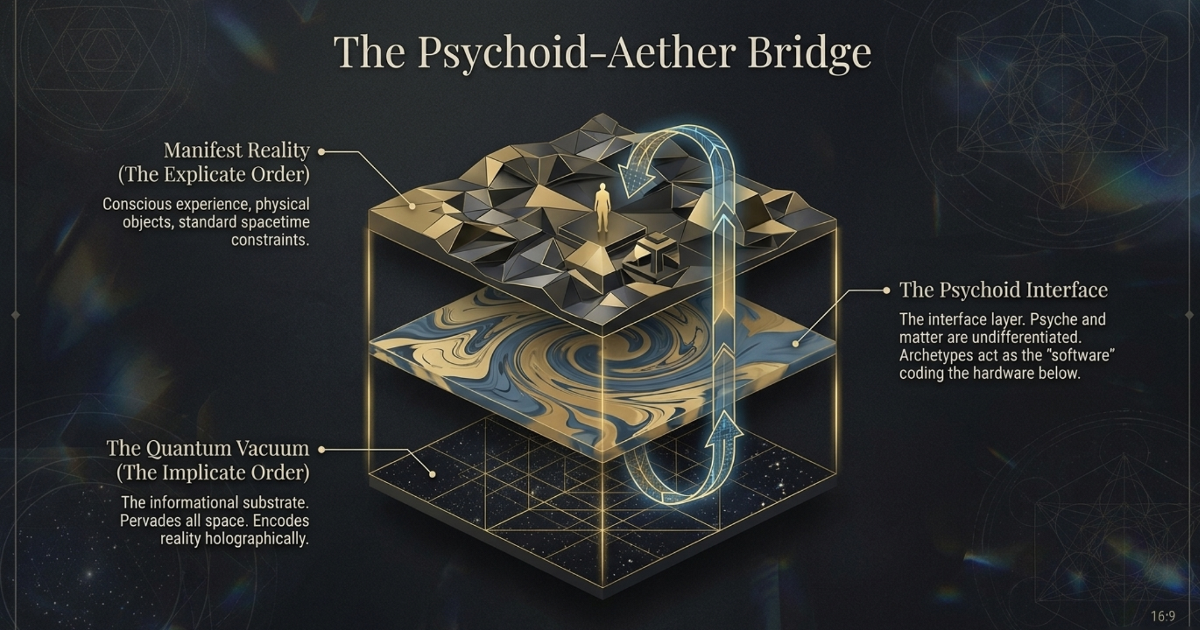
In my synthesis, the aether, or the quantum vacuum as a metaphorical informational substrate, is the “field” in which patterning can propagate. Again, not orthodox physics. It is a metaphysical architecture that helps explain why inner life is not a side story. It is upstream.
If you accept that, then archetypes are not just stories in the head. They become organizing patterns for both perception and lived events. The psychoid is the operating system layer, and the archetypes are recurring programs.
Takeaway 3: Reality is a Participatory, Holographic Projection
Rewriting the Informational Substrate
When I say “participatory,” I am pointing to the philosophical implications of observer involvement. John Wheeler is a key figure in that lineage, see John Archibald Wheeler. A strong interpretive profile that captures the tension between observation, meaning, and reality construction is “John Wheeler Saw the Tear in Reality” (Quanta Magazine).
When I say “holographic,” I am borrowing a real theoretical physics concept as a framing device. The Holographic principle is, in physics, about how a higher-dimensional region can be encoded on a lower-dimensional boundary. I use it to underline a practical point: what you experience as “solid reality” may be downstream of information constraints and interpretation layers.
This is where the Timeline Split becomes legible. If groups adopt incompatible foundational assumptions, they begin to encode different “data” into their shared field of attention. They share geography, but they no longer share premises. From there, the divergence is not just interpretive. It becomes behavioral, institutional, and eventually material.
So when I say “changing the information changes the reality,” I am not doing a slogan. I am describing a pipeline: information shapes perception, perception shapes action, action shapes institutions, institutions shape the future.
Takeaway 4: The “Blank Future” is a Moment of Maximum Agency
The Exhaustion of Old Paradigms
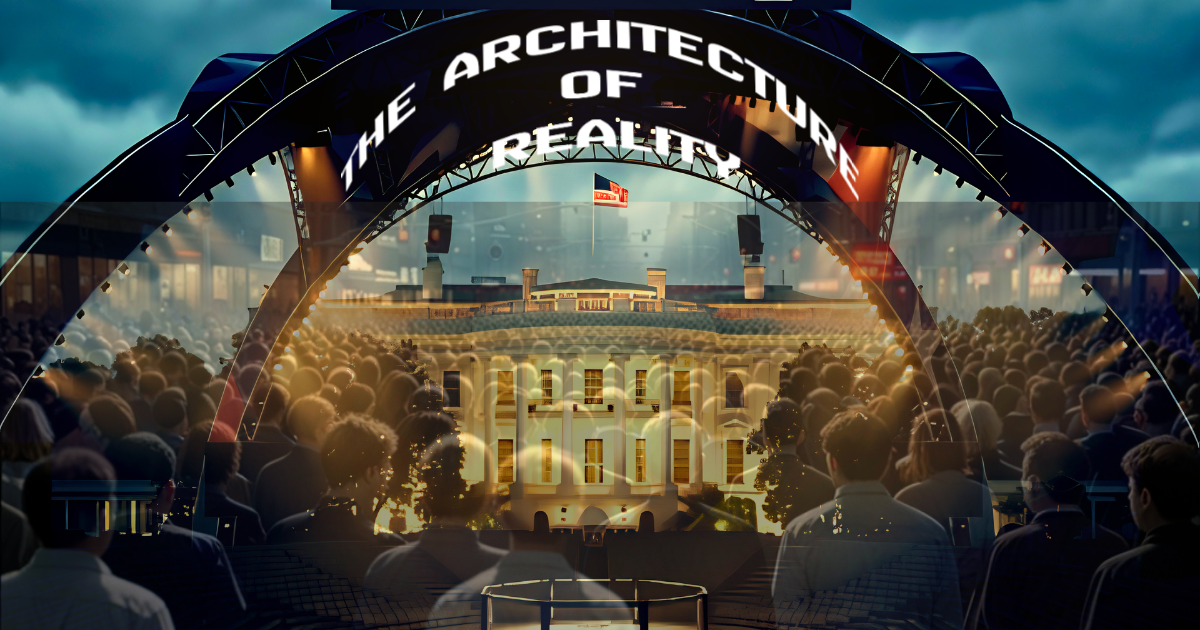
I describe the blank future as a convergence point. Not a void, but a release of constraint. When the old paradigm loses grip, the future becomes more plastic.
Thomas Kuhn’s work is relevant here because he explains why paradigm shifts are not simply debates with better evidence. They are restructurings of what counts as evidence. See The Structure of Scientific Revolutions and Kuhn’s discussion of incommensurability. My claim is that we are experiencing incommensurability at scale.
I also draw from long-cycle thinking through Peter Turchin as a reference point for structural stress and historical instability, see Peter Turchin. You do not need to agree with every model to see the utility of the frame: societies hit pressure thresholds, legitimacy declines, coordination fails, and new organizing stories become available.
So the blank future is not empty. It is underdetermined. When old structural forces weaken, the quality of collective attention, intention, and coordination matters more than it used to. That is both terrifying and empowering.
Takeaway 5: Hyperstition and the Engineering of Timelines
Fictions That Perform Themselves Into Truth
“Hyperstition” is one of the cleanest words I have found for something we all recognize. Narratives can become real by mobilizing belief and synchronized behavior. For a baseline definition, see Hyperstition.
When a narrative becomes persistent and group-binding, it begins to behave like an egregore, a collective thoughtform that influences members from within the shared field. See Egregore.
Now here is the strategic layer: modern actors understand this, and some have formalized it. “Cognitive warfare” is often discussed as an operational domain that targets perception, cohesion, and decision-making. A widely cited public reference is “Cognitive warfare” (NATO Review).
In my synthesis, algorithmic curation functions like automated hyperstition. It does not merely show you content. It trains your salience map, narrows your plausibility range, and nudges you into a self-reinforcing epistemic habitat. Multiply that across millions of people and you get reality-tunnel divergence. That is the Timeline Split as a lived phenomenon.
Conclusion: The Threshold of Choice
I do not experience the world as a fixed stage anymore. I experience it as a responsive informational field, one that humans participate in constantly, usually unconsciously.
The Timeline Split is what it looks like when internal divergence becomes external incompatibility. When shared paradigms exhaust themselves, the future becomes blank in the specific sense that it becomes more dependent on the signal we collectively provide.
The field is waiting. The question is simple and uncomfortable. Which reality are you encoding?
My Synthesis, Expanded: Reality in Current Environments
This is the bridge between the metaphysical language and the modern situation.
In our current environment, institutional trust is collapsing, material stress is rising, and algorithmic mediation is everywhere. That matters because my whole model depends on the receiver.
The Living Field framework gives me a practical way to say it. If the receiver is dysregulated, attention becomes unstable. If attention is unstable, intention becomes weak. If intention is weak, coherence is impossible. That theme is explicit in “Tuning the Receiver: Reconnecting to the Living Field”, and it is complemented by the embodied framing in “The Living Field of Consciousness: How Your Inner World Shapes Your Body”.
Here is the synthesis in a clean stack:
Field and interface (psychoid): There is a bridge layer where mind and matter are not fully separable; see Psychoid.
Receiver (nervous system and attention): Coherence is embodied and trainable; see The Living Field Studio.
Narrative entities (hyperstition and egregores): Group stories can self-reinforce into durable forces; see Hyperstition and Egregore.
Engineering layer (algorithms and ops): Perception can be deliberately shaped at scale; see NATO Review on cognitive warfare.
Collapse and opportunity (paradigms and cycles): When shared frameworks fail, agency becomes more decisive, see Kuhn and Turchin.
So when I say “collective coherence is the only cure for cognitive warfare,” I mean something very specific. The defense is not only fact-checking. The defense is signal quality. It is attention discipline. It is nervous system regulation. It is narrative hygiene. It is coordinated meaning-making that is strong enough to resist fragmentation.
We are no longer just living in history. We are authoring the substrate, at least at the human scale, where perception and coordination decide what becomes real.