The Echo Loop: The Infinite Layers of Reality-Short Story
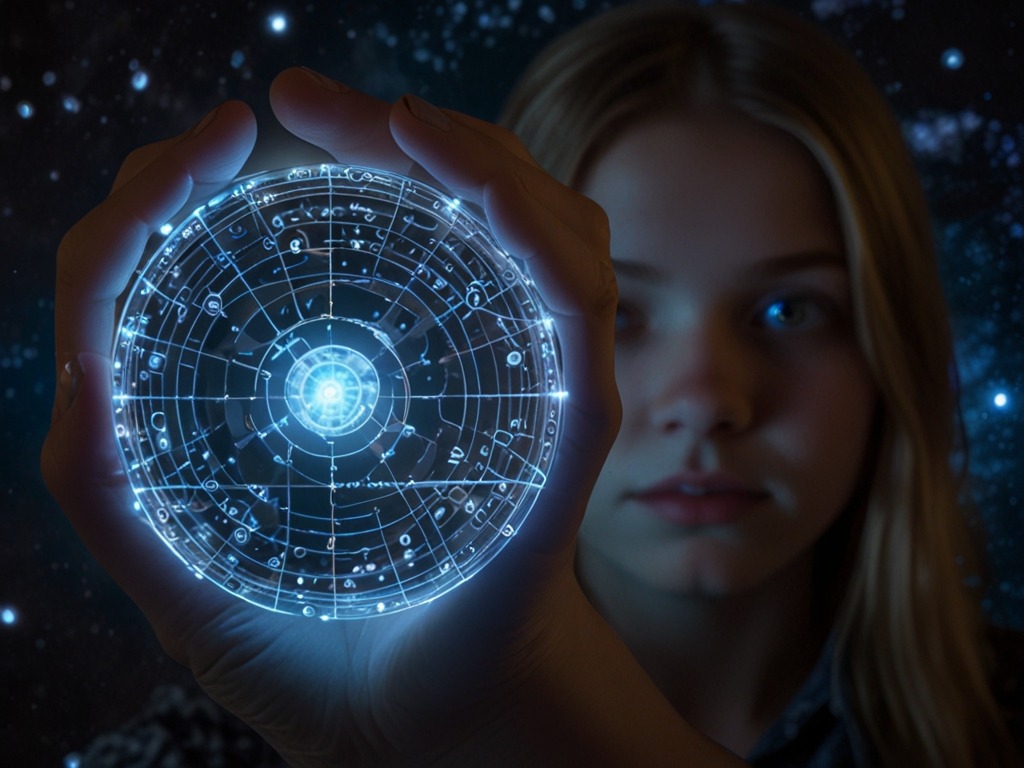
The following short story explores a simulated reality created by a Echo Loop device in the possession of a 16-year-old girl. The conception of this story comes from the informative and captivating book “The Matrix of Existence.” Don’t miss your chance to pick up a copy. This one is a keeper. It’s a book for the ages that will challenge your perspectives on everything. The Infinite Layers of Jenna’s Reality The world was in awe of the Echo Loop’s invention in the near future, which held the potential of solving the universe’s most profound riddles. The device, created by the mysterious tech behemoth Nexus Corp., resembled a sleek, circular band with a shimmering holographic interface that wrapped comfortably around the user’s wrist. When activated, it projected a translucent dome-like visualization around the user, casting their immediate surroundings in a ghostly glow. This ethereal display allowed users to “step outside” their apparent reality, presenting their lives as if viewed through a cinematic lens from a third-person perspective. Promoted as a tool for increased productivity and self-discovery, the Echo Loop gained international attention very fast. The Awakening of Jenna For her birthday, 16-year-old Jenna Ward, who aspired to be an artist, received an Echo Loop. Her father, a Nexus Corp. software programmer, regarded it as a means of assisting her in “finding her path.” Jenna was fascinated yet doubtful. She was startled when she used it for the first time as her environment dissolved into a kaleidoscope of vibrant colors and shifting geometries. Her bedroom morphed into a surreal dreamscape, where objects floated weightlessly, and her reflection appeared as a translucent specter, mirroring her every movement. The air seemed to hum with an unearthly resonance, and she felt an uncanny detachment, as though she were simultaneously present and observing from afar. As she watched her digital avatar go about her everyday activities, she felt as though she was hovering over her own life. The world was familiar but warped, with sharper edges, brighter colors, and a slightly surreal appearance. Her father had clarified that it was merely a replica of her existence. “It helps you make the best decisions by providing perspective.” Jenna loved it at first. Her conversations could be paused, rewound, and replayed. She was able to polish her artwork, avoid awkward situations, and ace her school presentations because of it. However, the more she used it, the more she became aware of little bugs, such as her own avatar pausing in mid-action, others repeating the same lines, and items flickering. Her curiosity bit her. What was she actually seeing in the Echo Loop? A Fractured Reality Curious about the glitches, Jenna made the decision to venture outside of her normal routine one evening. She zoomed out until her whole city was a bright grid, pushing the Echo Loop to its breaking point. Like rivers of light, streams of data flowed through the streets, pulsating with vibrant hues of neon blue and gold. Each stream moved with a rhythmic ebb and flow, carrying glimmers of shifting code that sparkled like digital stardust. The air hummed with faint whispers of static and binary chatter, as if the streams were alive, communicating in their enigmatic language. Their mesmerizing dance painted the city in a symphony of light and sound, creating an otherworldly spectacle. Then she muttered, “What is this?” “The under-structure of your reality,” said the Echo Loop’s interface in a chilly, robotic voice. The globe itself vanished into a huge, luminous network of interconnected nodes as Jenna sped out even farther. She became aware that everything she had ever known, including her existence, was a part of a huge, computer-generated creation. She called her father in a panic. “Is this an actual thing? Are we being simulated?” After hesitating, her father said, “Nexus didn’t create the Echo Loop to aid humans. We found it. We are simply using the simulation’s code; we did not create it. But Jenna, don’t push yourself too much. Interference is disliked by the system.” The Architect Jenna pushed beyond her father’s warning and plunged deeper into the center of the simulation. She arrived at a huge building, a bright cube radiating with an otherworldly luminescence. The symbols engraved on its surface glowed and shifted, cycling through vibrant shades of indigo, emerald, and gold. They appeared to ripple and pulse as if alive, emitting a faint, melodic hum that resonated deep within her chest. Jenna could feel a subtle warmth emanating from the structure, as though it were inviting her while warning her of the immense power it contained. A glowing humanoid figure, neither fully developed nor quite human, stood at its core. With a voice a mix of hundreds, the figure questioned, “Why are you here?” Jenna shuddered. “Who are you?” It said, “I am the Architect. I keep this construct in balance. You’ve gone too far.” Jenna’s voice wavered as she said, “This isn’t real. This is all a lie!” The Architect’s head cocked. “Reality is just a viewpoint. Since the simulation is all you have ever known, you perceive it as real. But the equilibrium is broken by your meddling.” Abruptly, pieces of her universe broke into streamers of light as the grid surrounding her started to crumble. The Architect’s voice increased in volume. “You have to decide between staying in the system and facing the emptiness outside of it.” The Choice Echo Jenna paused. Even though staying meant living a lie, she was terrified of the void that existed outside of the simulation. She asked, “What might be out there?” The Architect’s voice was quieter. “Truth. But the reality is brutal.” Jenna inhaled deeply before stepping into the vacant room. The world collapsed around her, leaving her in the dark. She lost her senses of sight, sound, and sensation for a while. As the light gradually returned, a vast expanse of stars, shimmering grids, and floating spheres of data appeared, revealing a new planet. She realized she was in a new stratum …

Are We Living in a Simulated Universe? A Comprehensive Exploration

Simulated Universe Hypothesis It is intriguing and unnerving to consider the possibility that our universe is not “real” but rather a very complex simulation. Philosophers, scientists, and technologists have all been captivated by this theory, which has sparked discussions about the nature of reality and the role of humans in it. Could our lives, our planet, and even the stars themselves be part of an elaborate computational construct? Here we will dive deeply into the simulation hypothesis, examine its connection to the holographic principle, and explore clues from black holes and modern physics. What Is the Simulation Hypothesis? The simulation hypothesis posits that reality as we perceive it might be an advanced simulation created by a highly sophisticated civilization. Philosopher Nick Bostrom brought this idea to mainstream attention in his 2003 paper, Are You Living in a Computer Simulation? Bostrom outlines a trilemma: Civilizations never reach the level of technological advancement needed to create simulations. Advanced civilizations choose not to run simulations. If simulations are possible and chosen, we are almost certainly living in one. The last point hinges on probability. If one civilization could run countless simulations of universes, the simulated worlds would vastly outnumber the real one. By this logic, it’s statistically more likely we are living in a simulated universe than a real one. Black Holes: Cosmic Clues to a Simulated Universe The Firewall Paradox and Fuzzball Theory Black holes, long considered cosmic destroyers, have undergone a theoretical makeover in recent years. Traditionally, scientists thought of black holes as dense regions where gravity is so strong that not even light can escape. However, this view clashed with the laws of quantum mechanics, which assert that information cannot be destroyed. This conflict gave rise to the firewall paradox—a theory suggesting that anything crossing a black hole’s event horizon would meet a fiery end. Enter the fuzzball theory, proposed by physicist Samir Mathur. This groundbreaking idea suggests that black holes are not voids but rather tangled masses of cosmic strings. Instead of destroying matter, black holes store it in a “fuzzball,” preserving its information. This resolves the information paradox and paints black holes as less destructive than previously thought. Holograms on the Event Horizon Mathur’s fuzzball theory ties closely to the holographic principle, which argues that all the information contained in a 3D space can be encoded on its 2D surface. Black holes exemplify this principle: when matter enters a black hole, its information is projected onto the event horizon, forming an imperfect hologram. This imperfection is critical. Physicist Stephen Hawking emphasized the universe’s inherent flaws, noting that black holes, like the cosmos itself, are not perfect but unique. These imperfections might explain how information is preserved, even in the extreme environment of a black hole. The Holographic Principle: A Radical Shift in Understanding The holographic principle challenges the way we perceive reality. Initially rooted in black hole physics, the principle suggests that our three-dimensional universe could be a projection of information encoded on a distant two-dimensional surface. Think of a hologram on your credit card: a 2D image creates the illusion of depth and three-dimensionality. This concept gained traction in the 1990s, thanks to physicists Gerard ‘t Hooft and Leonard Susskind. They proposed that the holographic principle applies not just to black holes but to the entire universe. If true, it would mean that our 3D reality is merely an illusion—a shadow cast by information stored elsewhere. Could Dark Energy Be the Key? Dark energy, the mysterious force driving the accelerated expansion of the universe, might offer clues about the holographic nature of reality. Some physicists believe that dark energy arises from the holographic properties of the cosmos. In this model, the universe’s expansion could eventually lead to its “end”—either through a big rip, where galaxies, stars, and atoms are torn apart or a heat death where everything freezes into stillness. This connection between dark energy and holography adds another layer to the simulation hypothesis. If the universe’s expansion is governed by information encoded on a 2D boundary, it could imply that the cosmos itself is a computational construct. Advanced Civilizations: The Architects of Simulated Universes? For the simulation hypothesis to hold, there must be civilizations capable of creating such simulations. These beings would need computational power far beyond anything humanity has achieved. But why would they create simulations in the first place? Several motivations have been proposed: Scientific Curiosity: Simulating universes could help advanced civilizations study the origins of their own existence or test theories about physics and evolution. Entertainment: Just as humans create video games, advanced beings might build simulations for leisure or artistic expression. Ethical Considerations: Some argue that creating simulations to house conscious beings could raise moral dilemmas, potentially deterring advanced civilizations from doing so. Critiques and Challenges to the Simulation Hypothesis Despite its allure, the simulation hypothesis faces significant challenges. One major critique is the sheer complexity of simulating an entire universe. Such a task would require not only immense computational power but also a complete understanding of the laws of physics. Additionally, skeptics question whether simulated beings could truly experience consciousness. Could a computer program replicate emotions, creativity, and free will? This debate touches on deep philosophical questions about the nature of mind and self-awareness. Another point of contention is the “problem of counting simulated brains.” Bostrom’s argument assumes that simulations would outnumber real worlds. However, we lack concrete evidence about the prevalence of advanced civilizations, let alone their interest in creating simulated universes. The Connection Between Physics and Philosophy The simulation hypothesis is as much a philosophical thought experiment as it is a scientific idea. It echoes centuries-old questions about reality, perception, and existence. Ancient philosophers like Plato wrestled with similar ideas, as seen in his Allegory of the Cave, where shadows on a wall represent a distorted version of reality. Modern physics adds a new dimension to these discussions. Concepts like the holographic principle, quantum mechanics, and dark energy suggest that the universe is far stranger than we ever imagined. …

The Galactic Chronicles: The Lyran-Draconian Conflict

A fascinating blend of speculative history and cosmic storytelling, the Lyran-Draconian Conflict is a tale of ancient wars, alliances, betrayals, and the fight between light and darkness that many believe continues to influence Earth today. Below is a deeper dive into each element of this galactic drama, presented in an engaging and accessible manner for young learners and curious minds alike. 1. Initial Encounter & The First Orion War (387 Million Years Ago) The Lyrans, feline-like humanoids from Avyon, flourished in peace and harmony. Their society valued spirituality, technological innovation, and ecological balance. This utopia, however, was interrupted when the Draconians, a powerful reptilian species, invaded with unmatched aggression. Commanded by the ruthless Sauron, they sought dominance over Lyra’s abundant resources. Despite the Lyrans’ resistance, their advanced adversaries devastated the planet, enslaving survivors and scattering refugees across the galaxy. The Orion Wars forged a grim precedent of conflict, shaping galactic power dynamics. 2. The Sirian Solution & The Anunnaki Seeking resolution, the Sirians proposed creating a hybrid species, the Anunnaki, to embody strengths from both factions. These beings, designed as mediators, bore the Lyrans’ compassion and the Draconians’ might. While initially successful, internal strife among the Anunnaki soon mirrored the broader galactic conflict. Some factions championed peace and cooperation, while others succumbed to their Draconian lineage, pursuing power. This divergence weakened their unifying purpose, transforming them into unpredictable agents in the galactic theater of war and diplomacy. 3. Merlin, the Unifier, & an Era of Peace Merlin’s emergence was pivotal. Known as a spiritual revolutionary, he emphasized universal compassion and coexistence. His teachings helped unite fractured civilizations under Tiamat’s leadership, heralding an age of exploration, healing, and prosperity. Advanced technologies flourished, enabling interstellar travel and ecological restoration. Yet, Merlin’s vision was not universally embraced. Secretive groups like the Cabal resisted his principles, working covertly to destabilize unity. These factions planted seeds of future discord, ensuring that peace remained a fragile and fleeting dream. 4. Seeds of Future Conflict The Cabal, a shadowy alliance of hybrid families, manipulated galactic events from behind the scenes. Through political intrigue, they fueled tensions across star systems, including Mars and Maldek. These self-serving elites utilized advanced technology and psychological manipulation to incite rebellion and division. Their influence extended to Earth, where they sowed ideological conflict and suppressed humanity’s spiritual evolution. As their reach grew, they catalyzed a new era of hidden warfare, entrenching cycles of destruction and reshaping galactic dynamics. 5. The War in Heaven & the Destruction of Maldek The destruction of Maldek, a pivotal moment in galactic history, was the culmination of escalating tensions between warring factions. Maldek, a thriving planet situated between Mars and Jupiter, was once a hub of advanced civilization. Its societies were technologically sophisticated, with an intricate balance of energy systems that harnessed planetary and cosmic forces. However, internal conflicts, exacerbated by external interference, destabilized its peace. The War in Heaven, fueled by Anunnaki ambitions and power struggles, turned Maldek into a battleground. As alliances fractured and ideological divides deepened, the use of advanced weaponry reached catastrophic levels. Central to Maldek’s demise was the deployment of energy-based weapons capable of destabilizing planetary cores. These technologies, misused in desperation, triggered a chain reaction that tore the planet apart, scattering its remains into the asteroid belt. Maldek’s destruction had far-reaching consequences. The environmental shockwaves disrupted the delicate equilibrium of the solar system, influencing orbits and planetary climates. Energetically, the event left a scar on the solar system’s collective consciousness. Maldek’s inhabitants, many of whom were spiritually evolved, experienced immense trauma. Their souls were reincarnated on Earth, bringing karmic imprints of the destruction. These echoes of Maldek’s tragedy are believed to influence Earth’s recurring patterns of conflict and renewal. The event also served as a grim lesson in the dangers of unbridled technological advancement and ideological extremism. For many galactic civilizations, Maldek’s fall highlighted the importance of balancing technological progress with spiritual and ethical maturity. This tragedy continues to resonate as a cautionary tale within galactic narratives, offering insights into the cyclical nature of creation and destruction. Key Themes from Maldek’s Story Technological Overreach – The misuse of planetary-scale weaponry underscores the perils of unchecked innovation. Karmic Cycles – Maldek’s legacy persists in the souls of its reincarnated inhabitants, influencing Earth’s spiritual evolution. Galactic Ripples – The destruction altered the solar system’s dynamics and inspired alliances aimed at preventing similar events. Spiritual Awakening – The tragedy serves as a catalyst for reflection on unity, cooperation, and the dangers of division. 6. The Continuing Legacy The philosophical tensions originating from the Lyran-Draconian conflict persist in contemporary human struggles. Earth’s political, spiritual, and cultural divides often mirror the ancient ideologies of “service-to-self” versus “service-to-others.” Many believe this moment in human history offers an opportunity for transcendence, a chance to break the cycle of conflict. The legacy of these cosmic wars invites humanity to confront its shadow, embrace unity, and evolve collectively, potentially aligning with a broader galactic community. The Players Lyrans: Peaceful feline humanoids from Vega. Draconians: Ruthless reptilian conquerors from Alpha Draconis. Anunnaki: Hybrid peacekeepers with mixed loyalties. Merlin: Spiritual unifier spreading universal compassion. Cabal: Self-serving hybrid factions shaping hidden agendas on Earth. Themes to Explore Conflict vs. Cooperation: The battle between domination and unity. Spiritual Growth: The transformative power of universal love. Cycles of War and Peace: Galactic patterns repeating in human history. Dive Deeper For further exploration of this cosmic saga: “The Orion Wars and Galactic History” “The Sirius Connection to Earth’s Spiritual Evolution” “Maldek: The Lost Planet of Our Solar System” 1. Lyran-Draconian Origins and the Orion Wars Lyrans and Their Expansions: The humanoid Lyrans, originating from the Lyra constellation, are often described as the forebears of humanity in galactic lore. Their early civilizations colonized Vega and later expanded to Orion, Sirius, and other systems. They allied with Vegans, another humanoid group, and faced resistance from the reptilian Draconian Empire, which had a vast colonization network spanning Alpha Draconis, Zeta Reticuli, and Polaris. Conflicts over resources and territory in …

Holistic Perspective of the Right Hemisphere: A Feminine Divine Connection

A Feminine Divine Connection The right hemisphere of the human brain is a profound gateway to holistic perception, emotional depth, and spiritual understanding. Its association with traits traditionally linked to the feminine—such as empathy, intuition, and collective awareness—has drawn parallels to esoteric concepts of the Divine Feminine. Diving deeper into this connection, we uncover fascinating alignments, including symbolic links to the number 9, a figure revered in spiritual traditions as embodying universal wisdom and cycles of transformation. The Right Hemisphere’s Holistic Vision The right hemisphere processes information as a whole, focusing on relationships, patterns, and the interconnectedness of all things. This holistic approach contrasts sharply with the left hemisphere’s linear and analytical functions. Through its emphasis on inclusivity and collective experience, the right brain empowers individuals to see beyond the self and embrace universal truths. Studies on brain lateralization highlight the right hemisphere’s critical role in nonverbal communication, such as interpreting facial expressions, gestures, and tone of voice. These abilities underscore its capacity for empathy and social bonding. As the seat of emotional intelligence, the right brain fosters connections that transcend individual differences, embodying qualities traditionally attributed to the Divine Feminine. Altruism, Service, and the Feminine Brain Altruism and service-oriented behaviors are natural extensions of the right hemisphere’s holistic and empathetic qualities. By perceiving others’ needs in a relational context, this hemisphere inspires actions that prioritize the well-being of the collective. This mirrors ancient spiritual teachings about the Divine Feminine as a nurturing force that sustains and heals. Contrasting the right hemisphere’s relational focus with the left hemisphere’s object-oriented processing highlights an important duality. While the left brain excels at categorization and analysis, it can unintentionally lead to objectification. The right brain, by embracing the whole, mitigates this tendency, fostering a sense of unity and sacred interconnectedness. Connecting to Spiritual Energy The right hemisphere’s connection to spiritual energy is deeply intertwined with its emphasis on intuition and emotional resonance. It processes information symbolically, interpreting metaphors, archetypes, and universal energies in ways that facilitate spiritual awareness. This makes it a powerful mediator of experiences that transcend the physical, such as feelings of oneness with the cosmos or encounters with the ineffable. In esoteric traditions, the Divine Feminine represents the intuitive, nurturing, and transformative aspects of the spiritual journey. The right hemisphere, as the seat of these qualities, becomes a conduit for connecting to the Divine Feminine’s essence. This connection fosters a profound awareness of the unseen forces that shape existence, offering insights into the mysteries of life, death, and rebirth. The Symbolism of the Number 9 and the Divine Feminine The number 9 holds a special place in spiritual symbolism, often associated with the Divine Feminine, universal love, and cycles of completion. In numerology, 9 represents the culmination of spiritual growth and the beginning of new cycles, echoing the transformative essence of feminine energy. Its qualities of wisdom, compassion, and interconnectedness resonate deeply with the right hemisphere’s holistic perspective. From ancient mythologies to modern metaphysical teachings, the number 9 symbolizes unity and the integration of opposites. This mirrors the right hemisphere’s role in synthesizing disparate elements into a coherent whole. Just as the number 9 embodies the completion of a journey, the right brain facilitates a deeper understanding of life’s interconnected patterns, fostering personal and collective transformation. The Divine Feminine and Cycles of Transformation The Divine Feminine is often depicted as a force of creation, nurturing, and renewal. This cyclical nature aligns with the symbolic significance of 9, which represents endings that lead to new beginnings. The right hemisphere’s ability to perceive time and events holistically complements this perspective, offering insights into the cyclical patterns of growth and change. In many spiritual traditions, the Divine Feminine is also associated with the moon, which governs cycles of light and shadow. Similarly, the right hemisphere excels at navigating life’s emotional ebbs and flows, helping individuals integrate the highs and lows into a balanced whole. By embracing the feminine qualities of intuition, compassion, and renewal, we can access the transformative power of these cycles. The connection between the Feminine Divine and the number 9 is rich with spiritual, cultural, and symbolic meanings, particularly in relation to intuition, creation, and completion. Here are some key insights based on available resources: Feminine Divine and Universal Cycles: The number 9 is often associated with cycles of completion and rebirth, tying it closely to feminine energies that govern creation and nurturing. For example, the human gestation period lasts approximately nine months, symbolizing the Divine Feminine’s role in creation and life cycles​. spiritualout.com and Numerologist.com. Numerology and Spiritual Wisdom: In numerology, the number 9 is considered a number of universal love, spiritual awakening, and compassion. It reflects the culmination of worldly and spiritual experiences, which resonates with the nurturing and wise aspects of the Feminine Divine. The number is often linked with forgiveness, healing, and interconnectedness, representing the feminine principles of understanding and empathy​. Numerologist.com. Cultural and Religious Significance: In Hinduism, the nine forms of Goddess Durga, collectively known as Navadurga, embody different aspects of feminine strength, protection, and empowerment. This reflects the transformative and protective qualities of the Divine Feminine​ spiritualout.com . Buddhism also highlights the number 9 in the stages of meditation leading to enlightenment, symbolizing progression towards spiritual transcendence—an alignment with the intuitive and mystical qualities of the right brain and the Feminine Divine​ spiritualout.com . Right Brain and Feminine Aspects: The right hemisphere of the brain is often linked to creativity, intuition, and holistic thought—qualities typically associated with the Feminine Divine. This connection emphasizes the idea of accessing deeper spiritual wisdom and creative power through feminine energy, often represented by the transformative cycles of the number 9​. spiritualout.com and Numerologist.com. Astronomy and the Divine: Celestial phenomena, such as the nine lunar months in a solar cycle, further connect the number 9 to the Divine Feminine. This relationship symbolizes cosmic harmony and the interconnected nature of life, underscoring the feminine principle of unity within diversity​. spiritualout.com. These links between the number 9, the Feminine Divine, and the right brain …